
Notes on luck
How to cultivate good fortune


‘Luck’ is a concept I have been thinking and reading about for many years. What interests me is how binary and contradictory perspectives on luck can be.
One end of the spectrum is nihilistic — most of life’s outcomes, good or bad, are out of your hands. It’s a view that removes scope for personal agency and leaves it all up to fate.
The other end of the spectrum is the classic self-help mantra that you can overcome any obstacle through dedication and sheer force of will. It’s captured in this saying by Ralph Waldo Emerson, often quoted by entrepreneur Peter Thiel:
"Shallow people believe in luck...Strong people believe in cause and effect".
As with most things, the reality is more nuanced and lies somewhere in the middle.
Given how broad this topic can be, I’ve adopted the form of notes or ‘jottings’ on luck, combining different things I’ve read and experiences I’ve had.
Here they are:
There are two types of luck: 1) blind luck (e.g., where you’re born, who your family is, getting in a freak car accident) and 2) luck you earn.
Blind luck can be very powerful. In particular, the country, time period and socioeconomic background you are born into account for a lot. As Malcolm Gladwell writes in Outliers, computing pioneer Bill Joy benefited heavily from circumstance. He was born at exactly the right time (the mid-1950s) at the dawn of personal computing. He also went to the University of Michigan, one of the few colleges in the US with a time-sharing computing system. This enabled him to spend countless hours programming before most people even had access to a computer. When combined with his talent and hard work, Joy made many foundational contributions to computing, including the Unix operating system and the early protocols for the Internet.
The luck you earn has a ‘surface area’. Think of it like catching rain. You can’t control when or how much it rains, but you can control the size of your bucket. Baseball executive Branch Rickey famously said, "luck is the residue of design”. When intelligence and effort combine, you can manufacture a lot more good fortune.
There are a few ways to increase your surface area of luck. The first is simply to make more contact with the real world. This can look like having conversations with strangers (often, the most cutting-edge information in any field is not written down anywhere), building things in public or hosting events that connect quite disparate groups of friends. And the most important factor to increase your surface area of luck is to simply take more shots on goal. A musician who makes hundreds of songs a year is more likely to get lucky and produce a hit than one who painstakingly creates one ‘perfect’ composition. Your rate of experimentation is the key variable, not the percentage of successes.

Seek asymmetric bets. Look for opportunities with capped downside (e.g., minimal financial outlay or that build ‘no regrets’ skills) and uncapped and non-linear upside (h/t to my friend Ben for this framing). This reduces the impact of bad luck and amplifies the impact of good luck. This is one of the reasons I’m planning to pursue more media projects over the course of this year — writing, hosting a podcast and making YouTube videos. They have a capped downside — I get to meet interesting people and build a storytelling and video production skillset. And by posting them on the internet, they also have the potential for non-linear and uncapped success.
Leave space for flexibility and spontaneity. If the right opportunity comes up, you need to have enough time and mental energy to capitalise on it. If you fill up every minute of every day with plans, you won’t have enough slack to take risks and take advantage of serendipity. This also applies financially. One of the reasons I’ve held off on getting a mortgage over the last couple of years (apart from Sydney’s ridiculous house prices) is that it would greatly reduce my degrees of freedom. It would stop me from taking any material risks in my career that could actually have an even higher upside than getting on to the bottom rungs of the property ladder.
Just increasing your surface area of luck is not enough. You still need to get a return on your luck. The best recent example of this is Jensen Huang and NVIDIA. NVIDIA’s chips and data centres are the ‘picks and shovels’ of the current AI revolution. But the company undoubtedly got lucky. Their graphics cards, originally developed for gaming, happened to be exactly what was needed for the parallel processing requirements of training neural networks and transformers. No one could have seen that coming. But NVIDIA’s meteoric rise also wasn’t pure chance. Its recent success is underpinned by CUDA - the programming platform that lets developers use NVIDIA’s GPUs for general-purpose computing. Jensen started investing in this platform in 2006, when it was a niche and unprofitable product searching for a market (and was punished by the stock market for it). But when he recognised just how perfectly it worked for AI, he doubled down massively, transforming Nvidia into the most valuable company in the world. Jensen calls it “luck founded by vision.”
Be wary of self-serving bias. This is the mindset that any good things that happen to you are due to your skills, and any bad things that happen to you are due to bad luck. This flips when looking at other people's successes and failures. It’s important to recognise when you simply had good fortune, as well as appreciate others’ skills and talent.
"We must believe in luck. For how else can we explain the success of those we don't like?" — Jean Cocteau
‘Who luck’ is extremely powerful. So much of life comes down to who you know. People in your orbit, like ex-colleagues, mentors and friends, will often open doors for you. Interestingly, Stanford research from the 1970s showed that ‘weak ties’ (casual acquaintances) are more powerful than ‘strong ties’ (close friends) in finding a new job. This is because your close friends tend to have the same information as you, while weak ties have access to opportunities and worlds you might never have heard of. So, it is important to treat everyone with humility and not see everything as a transaction. Be willing to give generously without expecting anything in return.
Process over outcomes. We often judge the quality of a decision based on its result. A good outcome means you made a good decision. But this is a dangerous way of thinking, because life is like poker, not chess. You can make the best decision possible at every point in a game of poker, but still lose because you don’t know what cards will be dealt and revealed. Or you can make a series of wrong decisions and still get lucky. Life is much the same. The takeaway from this is to focus on your process rather than your results. A bad outcome doesn’t make our decision wrong if we thought about the alternatives and probabilities in advance and allocated our resources accordingly. It just means that one event in a set of possible futures occurred. If you keep this in mind, you can better diagnose why something did or didn’t work out.
Expect to be lucky. If you believe that good outcomes are possible, you are more likely to be alert to opportunities and stay persistent. This can start a self-reinforcing cycle where you more easily recover from setbacks, have more success and strengthen your belief in good luck and optimism.
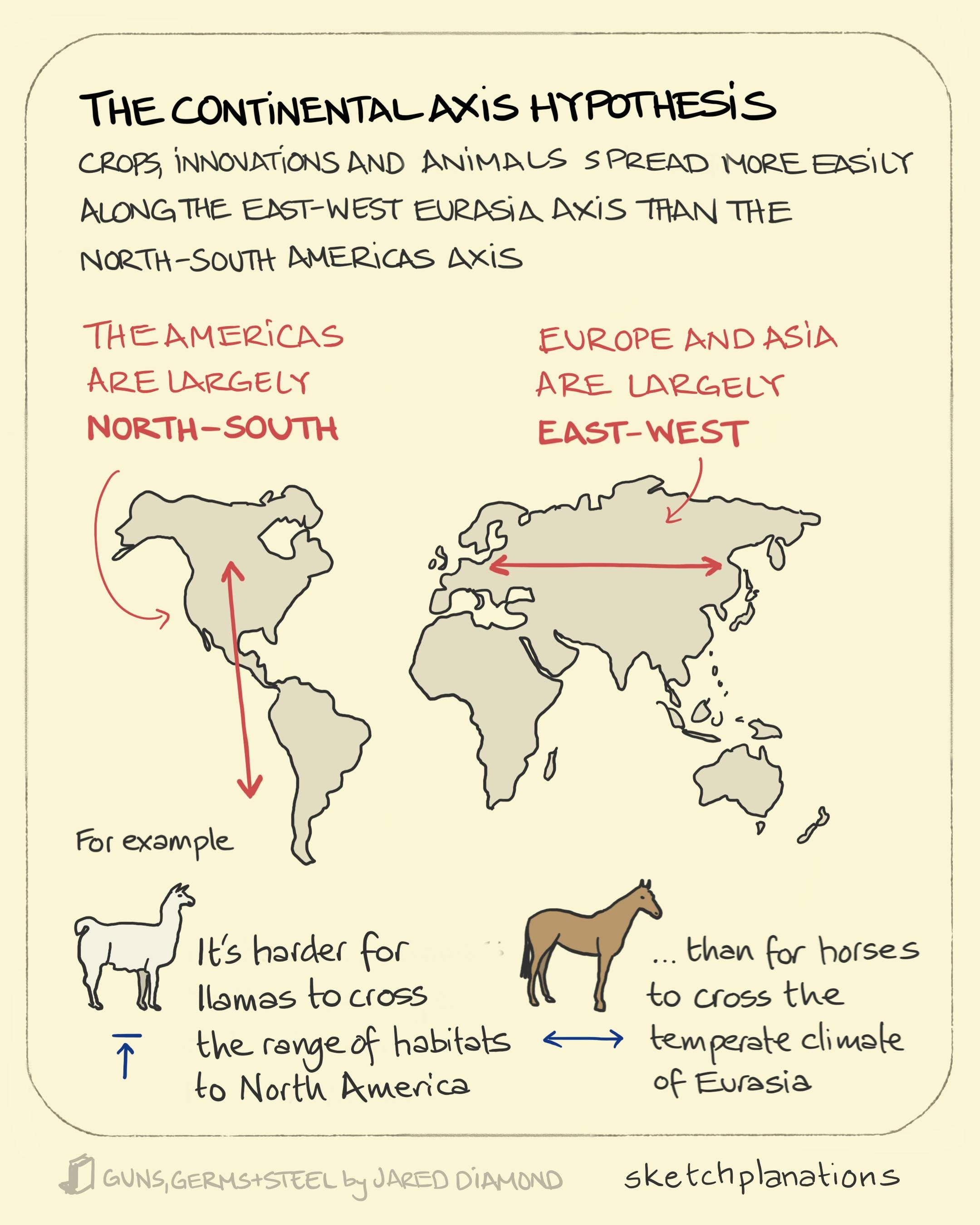
Geographical luck likely shaped world history. In Guns, Germs and Steel, Jared Diamond argues that the reason ‘Western’ powers have come to dominate the world is geographical luck, compounded over time. This applies in two ways. The first is that there were simply more species of animals and plants that could be domesticated in Europe, making it easier to practice agriculture and live in cities. Living in cities meant that people could better spread ideas and technology, as well as support larger armies. Living with animals also created immunity to diseases like smallpox, which ravaged native populations during colonisation. The second is the continental-axis hypothesis. If you look at a map, you’ll notice that the Americas and Africa are lined up North–South, while Europe and Asia are lined up East-West. It’s easier to spread societies east-west, because the climate doesn't change. This allowed Eurasian crops, animals and innovations to spread more rapidly, starting a prosperous snowball effect.
‘Serendipity’ has a fun etymology. British politician and writer Horace Walpole used it for the first time in 1754. The word comes from an old Persian fairy tale about three princes from Serendip (the ancient name for Sri Lanka) who were always making discoveries "by accidents and sagacity" of things they weren't looking for. What's interesting again here is the combination: accidents and sagacity. Not just stumbling into good fortune, but having the awareness to recognise it and capitalise on it when it appears.
I couldn’t have a post about luck have 13 points. So here is an extra one.
Some resources I relied on for this piece:
How to increase your surface area for luck by Cate Hall:

Update Log
I’m excited to join Jessy Wu and her team at Encour, a strategic communications agency that helps founders and companies command the narrative. I had a blast meeting the team this week and will be working at Encour a couple of days a week, helping out with their video productions.
Recommendation Zone
This week’s recommendation is Barbara Kingsolver’s Demon Copperhead (another banger recommendation from my girlfriend, Vaidehi).

It’s a reimagining of Charles Dickens’ David Copperfield, but set against the backdrop of rural Virginia and the opioid crisis. It follows the titular character from birth and the unrelenting challenges he faces with the foster-care system, high school and, eventually, addiction.
It’s a fairly large book, and it took me a while to really get into it. But for me, around the 60% mark, a lot of threads started to come together, and I became totally absorbed.
A great read if you want to learn more about the opioid crisis in America, the brutal economic realities of the decline of the US coal industry and the power of resilience in the face of it all.
great piece, really enjoyed it. Keep up the amazing work saurav!
Nice thoughts on LUCK!
Luck is often dismissed as a label for statistical probability in the mathematical world. Mathematical view is that winning lottery/race/bet is seen as a statistical randomness based on Permutations/Combinations and Probability theory. Odds of winning say 5 numbers out of 50 is 1 in over 2 million (I think!). Another is what Gamblers often think of the fallacy that after so many number of unlucky streaks they are due for a win.